Why Marketing Without a Strategy Wastes Your Budget
A retail brand doubles its advertising spend after a slow quarter, expecting sales to increase proportionally. Three months later, performance has barely improved, while the additional budget has been exhausted. This scenario is common across businesses—not because advertising is ineffective, but because increasing spend rarely solves a problem that was never caused by budget limitations in the first place.
A larger marketing budget cannot compensate for targeting the wrong audience, pursuing unclear objectives, or delivering a message that fails to connect. Before investing more in marketing, businesses need to understand where their budget is going, what is limiting performance, and whether their marketing activities are supported by a clear, strategic direction.
When strategy comes first, every marketing investment has a defined purpose, measurable objectives, and a stronger opportunity to contribute to sustainable business growth.
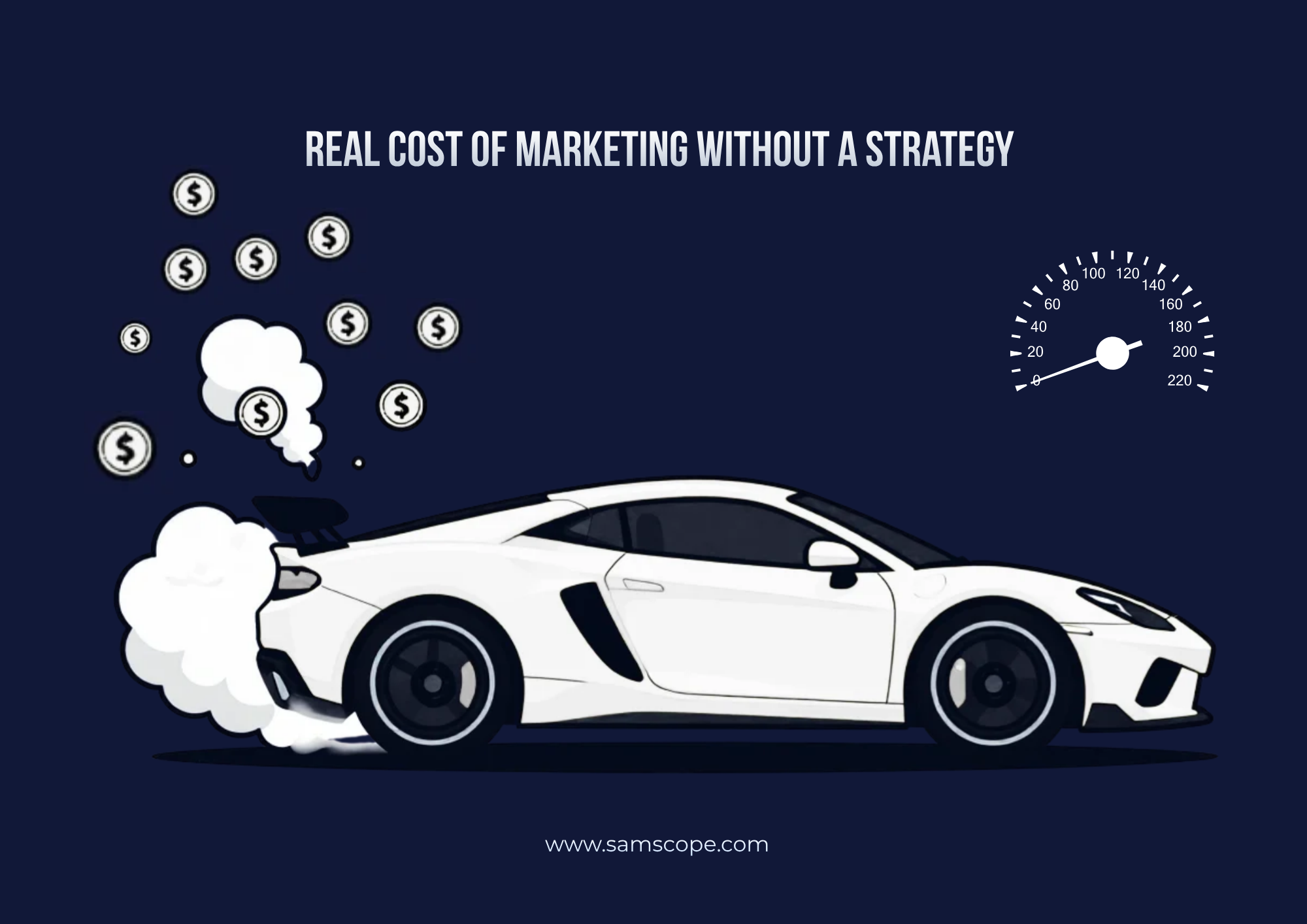
Real Cost of Marketing Without a Strategy
Running Facebook or Meta Ads, Google Ads, social media content, influencer partnerships, SEO, or promotional campaigns without a clear strategy is like pressing the accelerator while the car is still in neutral. The engine runs, fuel is consumed, and there is plenty of activity, but the vehicle moves no closer to its destination.
Without strategic direction, advertising may reach a broad audience instead of the right one. Content may be published without a defined purpose. Campaigns may be launched without clear objectives or reliable ways to measure their contribution to revenue.
The problem is not the marketing channels themselves. Facebook Ads, Google Ads, SEO, social media, and influencer marketing can all deliver strong results when they are aligned with a well-defined strategy. The real cost comes from using these channels without direction—leading to wasted budgets, inconsistent performance, and limited visibility into what is actually driving business growth.
Eventually, businesses are left with one critical question: Where is the marketing budget actually going?
Why Businesses Waste Their Marketing Budget
Marketing without a strategy is rarely the result of one major mistake. More often, it is the accumulation of small, disconnected decisions: launching an ad campaign because a deadline is approaching, publishing content simply because it is part of the weekly schedule, or adopting a new platform because a competitor is already using it.
Each decision may seem reasonable in isolation. However, without a unified strategy connecting these activities, marketing efforts can pull the budget in different directions rather than working toward a common business objective.
For a growing e-commerce brand, this might mean running Instagram ads to a broad audience, occasionally boosting posts, and launching discount campaigns every few weeks—without properly tracking which activities generate sales, acquire valuable customers, or drive repeat purchases. Over time, the brand continues spending without developing a clear understanding of what is actually contributing to sustainable growth.
Common Marketing Mistakes That Drain Your Budget
Marketing budgets are often wasted not because businesses invest too little, but because resources are allocated without clear strategic direction. Several recurring mistakes can significantly reduce marketing efficiency and limit business growth:
Targeting the wrong audience: Spending money to reach people who are unlikely to need, trust, or purchase the product or service.
Lack of clear marketing objectives: Running campaigns without specific, measurable goals makes it difficult to determine whether they have delivered meaningful results.
Poor brand positioning: Failing to clearly communicate what the brand offers, who it serves, and why customers should choose it.
Weak or inconsistent messaging: Delivering disconnected messages across advertising, social media, content, and the website, which can weaken brand clarity and customer trust.
Creating content without a strategy: Publishing content without a defined purpose, target audience, or connection to broader business and marketing objectives.
Running ads without proper planning: Launching campaigns without a structured strategy, funnel, budget allocation, or defined customer journey.
Poorly optimized landing pages and websites: Driving valuable traffic to digital experiences that are difficult to navigate, unclear, or ineffective at converting visitors.
Focusing on vanity metrics: Prioritizing clicks, likes, impressions, and reach instead of meaningful outcomes such as qualified leads, conversions, revenue, and customer retention.
Failing to track conversions and customer journeys: Making it difficult to identify which channels, campaigns, and touchpoints are actually contributing to business results.
Neglecting performance analysis: Failing to review campaign data and identify what worked, what did not, and what should change.
Continuing ineffective campaigns: Allowing underperforming campaigns to consume budget without testing, optimization, or strategic adjustments.
Changing strategies too frequently: Abandoning campaigns or approaches before collecting enough data to evaluate their effectiveness and make informed decisions.
When these issues occur repeatedly, even a substantial marketing budget can produce limited results. A clear strategy helps businesses identify where resources should be invested, how performance should be measured, and what needs to be optimized for sustainable growth.
Marketing Spending vs. Marketing Investment
There is a fundamental difference between spending a marketing budget and investing in marketing—similar to the difference between renting a home and building equity through a mortgage. Renting is primarily transactional: you make regular payments, receive a temporary benefit, and at the end of the period, you have little lasting value to show for those payments.
Marketing without a strategy can work in much the same way. Budget is spent, an advertisement runs, a post is published, and the cycle starts again the following month with little connection to previous results. Without proper tracking, analysis, and optimization, each campaign operates almost independently, making it difficult for the business to learn from its marketing activities.
Investing in marketing means creating a system where every campaign builds on the insights, data, and results generated by previous efforts. Each activity contributes to a deeper understanding of the target audience, stronger messaging, more effective channels, and better allocation of resources over time.
For example, a growing company may spend the same amount as a competitor but achieve significantly stronger results because its campaigns are guided by insights from previous performance. Instead of repeatedly starting from scratch, the business continuously improves its marketing approach based on what the data reveals.
Over time, this compounding effect of knowledge, optimization, and strategic improvement can become a significant competitive advantage. Businesses that treat marketing as an investment are not simply spending money to generate short-term activity—they are building a marketing system that becomes more efficient, informed, and effective with every cycle.
Let’s take a closer look at the difference between marketing spend and marketing investment and understand how the way a business allocates its marketing budget can influence both short-term performance and long-term growth.
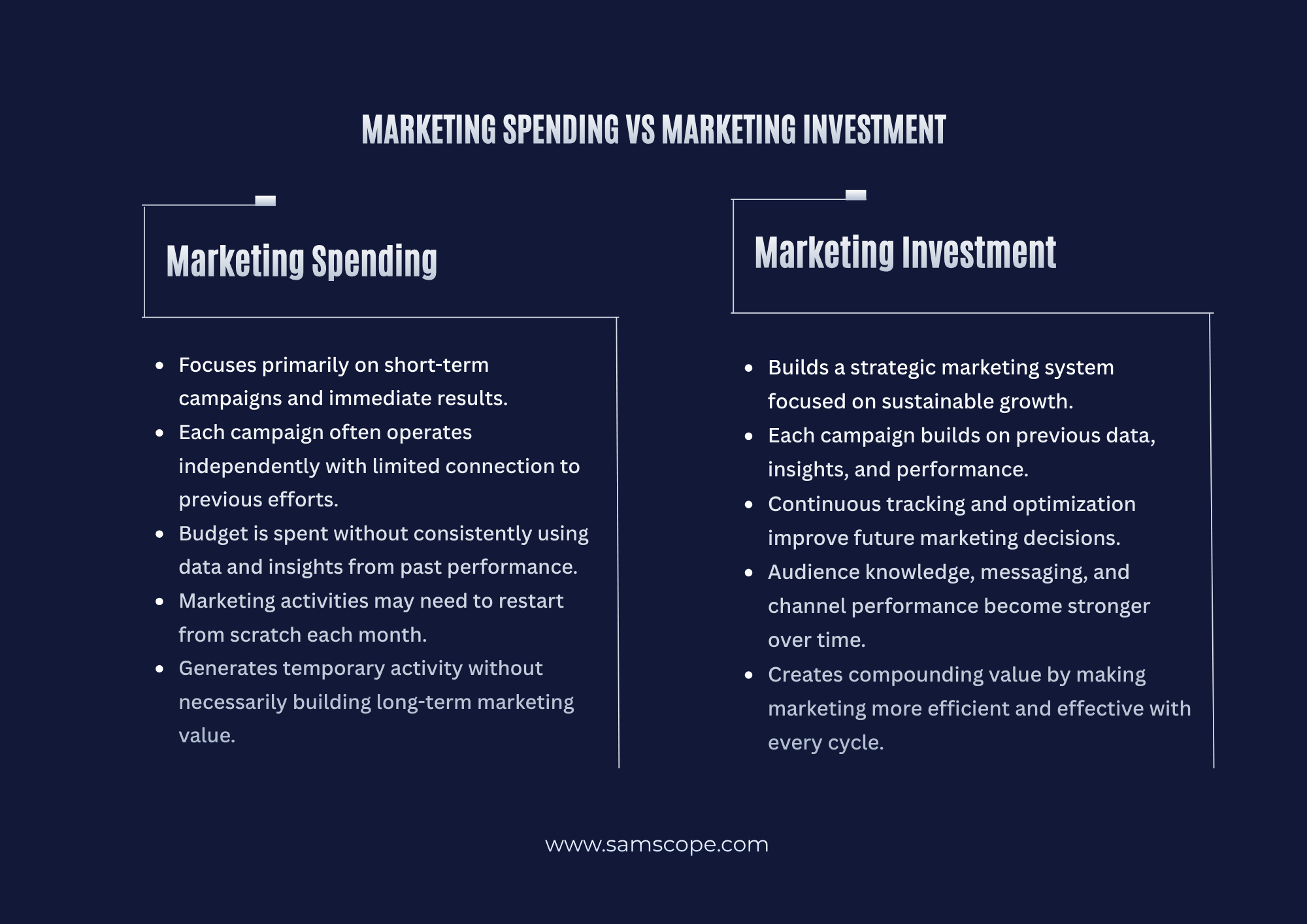
The visual below demonstrates the fundamental difference between marketing spending and marketing investment. It highlights how spending focuses primarily on short-term activities and immediate outcomes, while investment builds a strategic marketing system where data, insights, optimization, and results continuously contribute to long-term growth.
How a Strategic Approach Makes Your Budget Work Smarter
A strategic approach does not necessarily mean spending less; it means spending with purpose and direction. Instead of continuously shifting the budget toward whichever campaign appears most urgent, businesses can allocate resources to channels supported by research, audience insights, and measurable business objectives. This helps reduce unnecessary spending without reducing the overall effectiveness of marketing efforts.
Strategic thinking also influences what happens after an audience encounters a brand. When content, advertising, and messaging are aligned with the needs and expectations of customers at each stage of their journey, more qualified traffic has the opportunity to move toward conversion rather than dropping off along the way.
Over time, this approach replaces guesswork and short-term trends with data-driven decision-making. Each campaign generates insights that can inform the next, allowing the business to continuously improve its targeting, messaging, channels, and budget allocation.
The result is more than better campaign performance. It creates a marketing system where knowledge and brand value can compound over time, rather than allowing results to reset with every new campaign.
The Role of Data, Tracking & Optimization
Strategy without measurement is still guesswork—only with better intentions. Data, tracking, and performance measurement are essential for turning a marketing strategy into a system that can continuously improve. By tracking conversions, customer journeys, campaign performance, and key marketing metrics, businesses can identify what is working, what is underperforming, and where resources should be reallocated.
Without proper tracking, businesses may continue investing in ineffective campaigns simply because there is no reliable data to reveal the problem. This can lead to wasted budgets, missed opportunities, and repeated mistakes.
Continuous optimization is what transforms individual campaigns into an increasingly efficient marketing system. By using real performance data to refine targeting, creative assets, messaging, offers, and channel allocation, businesses can improve results over time rather than relying on assumptions.
However, optimization also requires patience and consistency. A common mistake is reacting to short-term performance fluctuations by making major strategic changes before sufficient data has been collected. Effective optimization means identifying meaningful patterns, understanding the reasons behind performance changes, and making informed adjustments based on reliable evidence.
When tracking and optimization become part of the marketing process, every campaign becomes an opportunity to learn, improve, and make the next investment more effective.
Why Your Business Needs a Strategic Marketing Roadmap
Many common marketing challenges—including incorrect audience targeting, inconsistent messaging, ineffective campaigns, and limited performance tracking—can be traced back to one fundamental issue: the absence of a clear strategic plan that connects marketing activities with broader business objectives.
A strategic marketing roadmap addresses this gap by establishing a structured process for planning, executing, measuring, and improving marketing activities. It begins with analyzing the business, target audience, market, and competitive environment. Based on these insights, businesses can develop a focused strategy, implement it across the most relevant channels, measure performance, optimize based on data, and scale the approaches that consistently deliver results.
This structured approach ensures that marketing activities are not treated as isolated campaigns. Instead, every investment, channel, and initiative works toward a defined business objective, creating greater efficiency, accountability, and long-term growth potential.
Ultimately, a strategic marketing roadmap helps businesses move from random marketing activities to a connected, measurable, and scalable growth system.
How Samscope Helps Businesses Market Strategically
Samscope’s Strategic Digital Marketing Solution for Sustainable Growth is designed to address the gap between marketing expenditure and meaningful business results. Rather than simply recommending another advertising campaign or content package, Samscope begins by analyzing how a business’s current marketing budget is being allocated, which audiences it is reaching, and whether those investments are aligned with the company’s broader business objectives.
Based on these insights, Samscope integrates branding, content, SEO, paid advertising, and retention marketing through email and SMS into a coordinated marketing strategy. Instead of treating each channel as a separate activity competing for the same budget, every component works together toward defined business goals.
The result is a more structured and measurable marketing system—one that learns from performance, continuously improves through data and optimization, and becomes more effective over time.
With the right strategic foundation, a marketing budget can move beyond being a recurring monthly expense and become a long-term investment in sustainable business growth.
Conclusion
Marketing budgets rarely underperform simply because a business is not spending enough. More often, the problem is that marketing expenditure is not supported by a clear strategy that connects investment to measurable business objectives.
A strong marketing strategy does more than determine where to allocate the budget. It defines why the investment is being made, who it is intended to reach, what message should be communicated, which channels should be used, and how success will be measured.
If your current marketing campaigns are not delivering results that justify the investment, increasing the budget may not be the right solution. The first step may be to identify what is limiting performance and rebuild the strategy around your actual business goals.
Book a free consultation with Samscope to evaluate your current marketing approach and determine whether your business needs a larger investment—or a stronger strategy behind the investment.