What Is Strategic Digital Marketing and Why Does Your Business Need It?
Every business today engages in some form of digital marketing—whether through Facebook advertising, Instagram content, Google Search campaigns, or other digital channels. However, executing digital marketing activities and implementing them strategically are two very different things.
Many businesses consistently invest in advertising and content but struggle to achieve meaningful, sustainable growth because their marketing efforts are often disconnected and lack a clear strategic direction. Without a structured plan, individual campaigns may generate short-term results but fail to contribute to long-term business objectives.
This is where strategic digital marketing creates a significant difference. It connects business goals, audience insights, market positioning, content, channels, advertising, and performance measurement into a coordinated marketing system.
In this guideline, we will explore what strategic digital marketing means, why disconnected and random marketing activities often fail to deliver lasting results, and how a structured, strategy-driven approach can help businesses achieve sustainable growth rather than continuously chasing short-term wins.
What Is Strategic Digital Marketing?
Strategic digital marketing is a planned, research-based approach to marketing in which every campaign, channel, and message is designed to support specific business objectives. Rather than publishing content or launching advertisements simply to remain active online, a strategic approach begins by understanding the business, its target audience, competitive environment, and market position before any marketing activity is implemented.
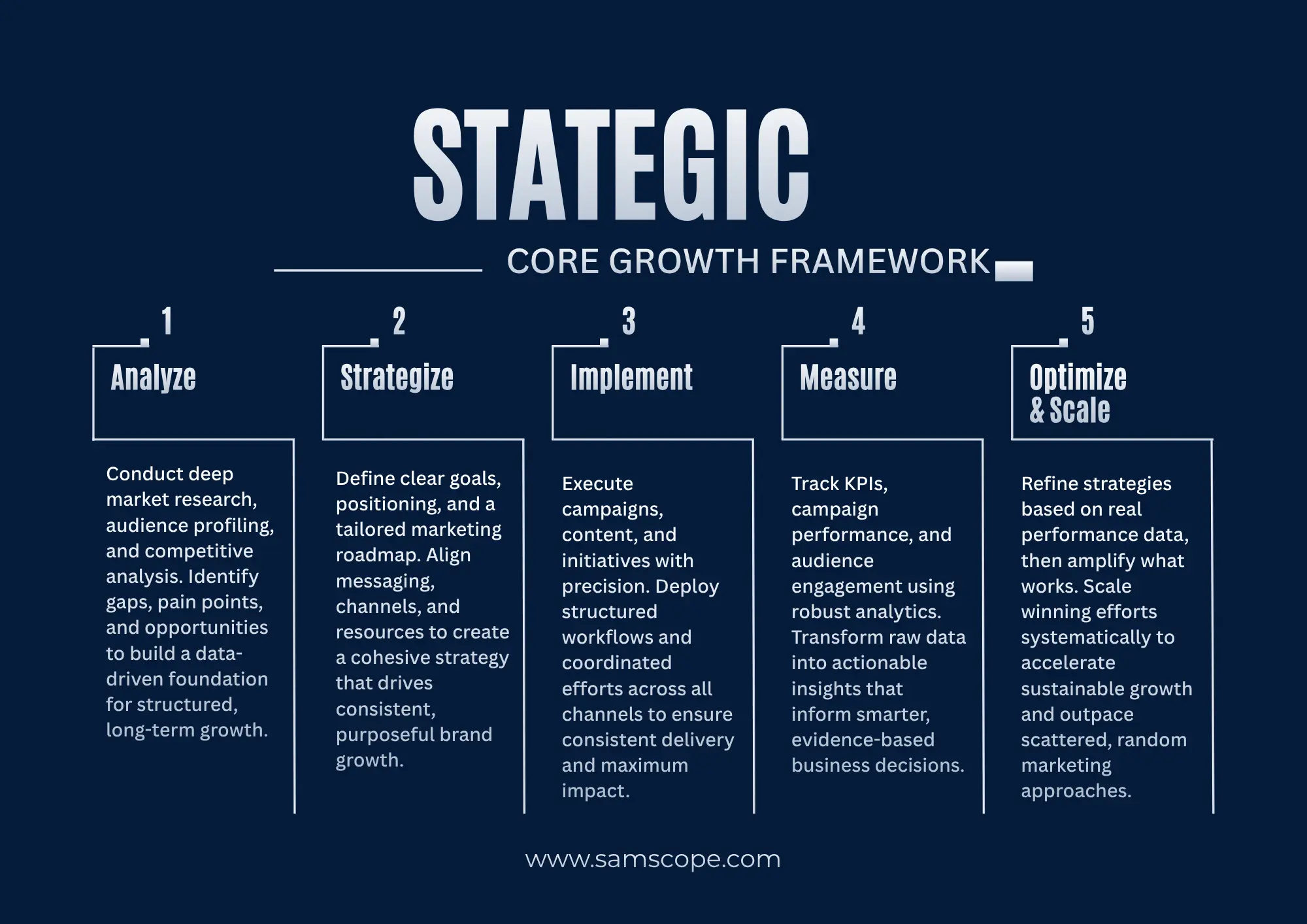
A strategic digital marketing process typically follows a structured framework such as analyze the business and market, define the strategy, select the right channels, implement the plan, measure performance, optimize based on data, and scale the strategies that deliver results.
This approach goes beyond simply maintaining a digital presence. Being active on social media, running advertisements, or publishing content does not automatically create sustainable growth. Strategic digital marketing focuses on direction, alignment, and measurable outcomes—not merely on marketing activity.
By connecting business objectives with audience needs, market opportunities, positioning, marketing channels, and performance data, businesses can build a more structured marketing system that supports consistent performance and long-term sustainable growth.
Random Digital Marketing vs. Strategic Digital Marketing
Random digital marketing is often driven by immediate actions rather than a clear strategy. A business may boost a post simply because a competitor is doing it, launch an advertisement without clearly defining its target audience, or publish content inconsistently based on availability and convenience. While these activities create an online presence, they often lack a clear purpose, direction, and connection to broader business objectives.
Strategic digital marketing, on the other hand, begins with research, analysis, and planning. Every piece of content, advertising campaign, email, and marketing activity is connected to a defined target audience, specific business objective, and measurable performance indicator. This ensures that individual marketing activities work together as part of a broader strategy rather than operating independently.
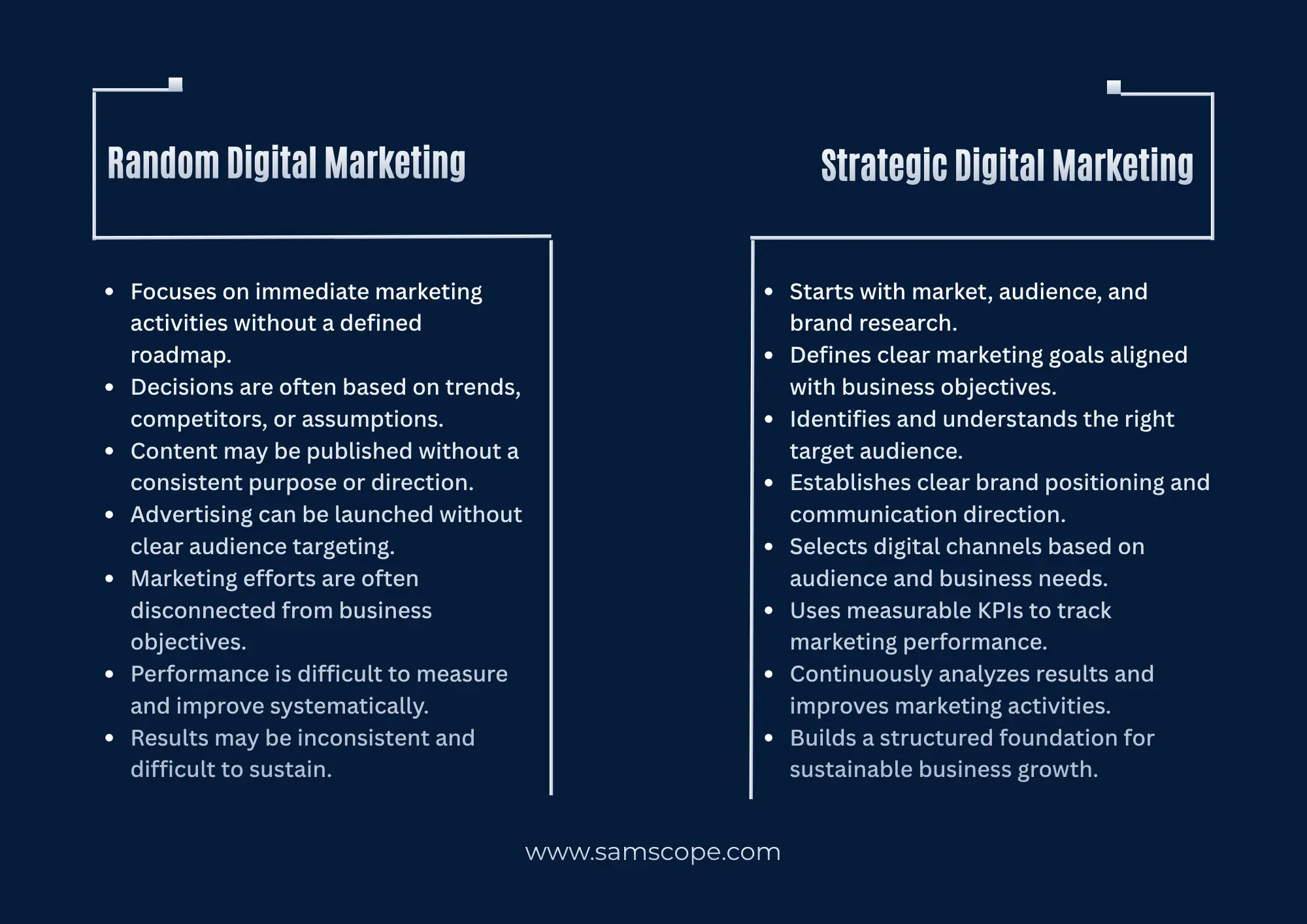
The difference becomes increasingly visible over time. Random marketing often produces inconsistent and difficult-to-explain results, making it challenging to identify what is working and why. Strategic marketing, however, creates a structured system that becomes more effective as data and insights accumulate. Each campaign provides valuable information that can be used to refine future decisions, allowing the business to continuously improve rather than starting from scratch with every new marketing activity.
Ultimately, the difference is not simply about how much marketing a business does, but how intentionally and strategically those activities are connected to business goals.
Why Random Marketing Activities Are Not Enough
Publishing content or running advertisements without a clear strategy is similar to watering an entire garden by spraying water in every direction and hoping it reaches the plants that actually need it. While this approach may generate some traffic, engagement, or visibility, it rarely produces consistent leads, conversions, or revenue.
Without a clearly defined target audience, advertising budgets can be spent reaching people who have little interest or intention to purchase. Without specific marketing objectives, it becomes difficult to determine whether a campaign genuinely delivered results or simply created the appearance of activity. Similarly, without a well-defined content strategy, messaging can change from one post to another, making the brand less consistent and gradually weakening recognition and positioning.
Over time, these disconnected activities can turn into a recurring marketing expense without a clear understanding of the return on investment. Businesses may continue spending on content and advertising each month without knowing which activities are contributing to meaningful growth—much like repeatedly filling a watering can without evaluating which plants are actually growing.
This is the core problem that strategic digital marketing is designed to solve. It provides the direction, structure, and measurement needed to ensure that marketing resources are focused on the right audience, the right activities, and the right business objectives.
Why Your Business Needs Strategic Digital Marketing
A strategic approach transforms how a business utilizes its digital marketing investment. Rather than treating marketing as a series of disconnected activities, strategic digital marketing creates a clear and structured system that connects marketing efforts with business objectives.
It helps build a stronger and more recognizable brand by maintaining consistency across messaging, content, and campaigns. It also enables businesses to focus on the right audience rather than simply reaching the largest possible audience, resulting in more qualified leads, stronger engagement, and improved conversion opportunities.
Strategic digital marketing also strengthens customer relationships by creating a clear customer journey that guides prospects from awareness and consideration to conversion and long-term engagement. Instead of focusing solely on one-time transactions, businesses can develop meaningful and lasting relationships with their customers.
Perhaps most importantly, a strategic approach helps reduce wasted marketing expenditure. When decisions are guided by research, performance data, defined objectives, and continuous optimization, businesses can allocate their resources more effectively instead of relying on trends, assumptions, or guesswork.
Over time, the combination of clear direction, consistent execution, data-driven decision-making, and continuous optimization enables businesses to build sustainable growth and reduce their dependence on unpredictable short-term spikes in traffic, engagement, or sales.
Key Elements of a Strategic Digital Marketing Approach
A successful digital marketing strategy is not built around isolated tactics. It is a connected system of strategic elements that work together to support business objectives, reach the right audience, and drive measurable growth.
Brand Positioning
Clearly defining what the business stands for, what differentiates it from competitors, and how it should be perceived in the market.
Target Audience Analysis
Identifying and understanding the ideal customers, including their needs, behaviors, preferences, challenges, and purchasing motivations.
Competitor Analysis
Evaluating competitors to identify market gaps, competitive advantages, emerging opportunities, and areas where the business can differentiate itself.
Marketing Goals and KPIs
Establishing clear, measurable objectives and defining key performance indicators to evaluate progress and determine whether marketing activities are delivering the desired outcomes.
Content Strategy
Developing purposeful and consistent messaging that communicates the brand's value proposition and supports customer needs across relevant digital channels.
Social Media Marketing and SEO
Building sustainable visibility through a combination of organic reach, search engine optimization, social media engagement, and other relevant digital channels.
Paid Advertising
Using targeted advertising campaigns to reach relevant audiences efficiently, with proper audience segmentation, budget allocation, and performance tracking.
Customer Journey Mapping
Understanding and structuring the stages a customer moves through—from initial awareness and consideration to conversion, retention, and long-term engagement.
Data Analysis and Continuous Optimization
Monitoring performance, analyzing meaningful data, identifying opportunities for improvement, and continuously refining marketing activities based on actual results rather than assumptions.
When these elements are strategically aligned, digital marketing becomes more than a collection of individual tactics. It becomes an integrated marketing system where every activity has a clear purpose, supports the broader business strategy, and contributes to sustainable growth.
How Strategic Digital Marketing Supports Sustainable Growth
Short-term marketing campaigns can generate temporary increases in traffic, engagement, or sales, but these results do not necessarily create lasting business growth. Sustainable growth requires a long-term marketing roadmap that provides a structured path for planning, execution, measurement, and continuous improvement.
A strategic approach can follow a clear cycle such as analyze, strategize, implement, measure, optimize, and scale. This allows businesses to learn from previous performance and use those insights to improve future marketing activities rather than starting from scratch with every new campaign.
This continuous process is what transforms short-term results into sustainable growth. Brand awareness strengthens over time, audience insights become more accurate, marketing decisions become more informed, and ongoing optimization improves campaign effectiveness. Each successful activity contributes data and learning that can make subsequent strategies more efficient and effective.
Businesses that focus on long-term roadmaps rather than isolated campaigns are better positioned to establish a stronger market presence, build lasting customer relationships, and achieve consistent growth instead of relying on short-lived increases in attention, traffic, or sales.
Why Businesses Choose Samscope
This is the approach Samscope is built around. Rather than providing isolated digital marketing services, Samscope delivers a Strategic Digital Marketing Solution for Sustainable Growth, built around a structured framework such as analyze, strategize, implement, measure, optimize, and scale.
Every engagement begins with a clear understanding of the business, its target audience, competitive environment, and market position before developing any content, advertising campaign, or marketing activity. This strategic foundation ensures that every marketing decision has a defined purpose and contributes to broader business objectives.
Businesses working with Samscope are therefore not simply purchasing individual marketing services. They are building a long-term, integrated marketing system across branding, content, SEO, advertising, and customer retention channels such as email and SMS. Each component is strategically aligned and guided by measurable objectives rather than operating as a collection of disconnected tactics.
Through this approach, Samscope helps businesses move beyond short-term marketing activities and build a structured digital marketing system designed for measurable performance, continuous improvement, and sustainable growth.
Conclusion
Digital marketing success is not determined simply by how frequently a business publishes content or how much it spends on advertising. Sustainable results come from having a clear strategy, consistent execution, and continuous optimization. Businesses that approach digital marketing as an integrated, long-term system are better positioned to achieve consistent growth than those relying on disconnected campaigns, trends, or guesswork.
A strategic approach ensures that every marketing activity has a clear purpose, reaches the right audience, supports broader business objectives, and contributes to measurable outcomes. Over time, this creates a stronger foundation for brand growth, customer acquisition, retention, and long-term market positioning.
If your business is ready to move beyond guesswork and build a structured, data-driven digital marketing strategy, Samscope can help. Book a free strategic consultation with Samscope today and take the first step toward building a digital marketing system designed for sustainable growth.