Why Every Business Needs a Long-Term Digital Marketing Roadmap
Two businesses can launch in the same month, with similar budgets, comparable products, and similar target audiences. Yet, one may build a recognizable brand, develop a growing base of repeat customers, and make its marketing increasingly efficient within a year. Meanwhile, the other may continue running the same types of campaigns it started with, struggling to understand why growth has stalled.
The difference is rarely talent or budget. More often, it comes down to having a clear, long-term digital marketing roadmap—or not having one at all.
A successful marketing strategy goes beyond running individual campaigns or reacting to short-term opportunities. It requires a structured direction that connects brand building, audience understanding, content, customer acquisition, retention, performance measurement, and continuous optimization.
This guideline explores what a true long-term digital marketing roadmap looks like, why short-term campaigns and disconnected marketing activities cannot replace one, and how a structured approach can transform marketing from a recurring expense into a sustainable growth engine.
What Is a Long-Term Digital Marketing Roadmap?
A long-term digital marketing roadmap is a structured strategic plan that defines a business’s marketing direction, priorities, and growth activities over an extended period—typically across several months or years—rather than treating each campaign as an isolated initiative.
It brings together key elements such as business objectives, audience and competitor analysis, content and channel strategy, budget allocation, performance measurement, and optimization. These elements are organized according to the business’s current position, available resources, market conditions, and long-term growth goals.
However, a roadmap is not a rigid, one-time plan. It provides a clear strategic direction while allowing flexibility in execution. As performance data, customer behavior, and market conditions evolve, specific tactics can be reviewed, refined, and optimized without losing sight of the broader business objectives.
Random marketing vs Short-Term Campaigns vs Long-Term Marketing Roadmap
It is useful to view marketing through three distinct approaches: random marketing activities, short-term campaigns, and a long-term marketing roadmap.
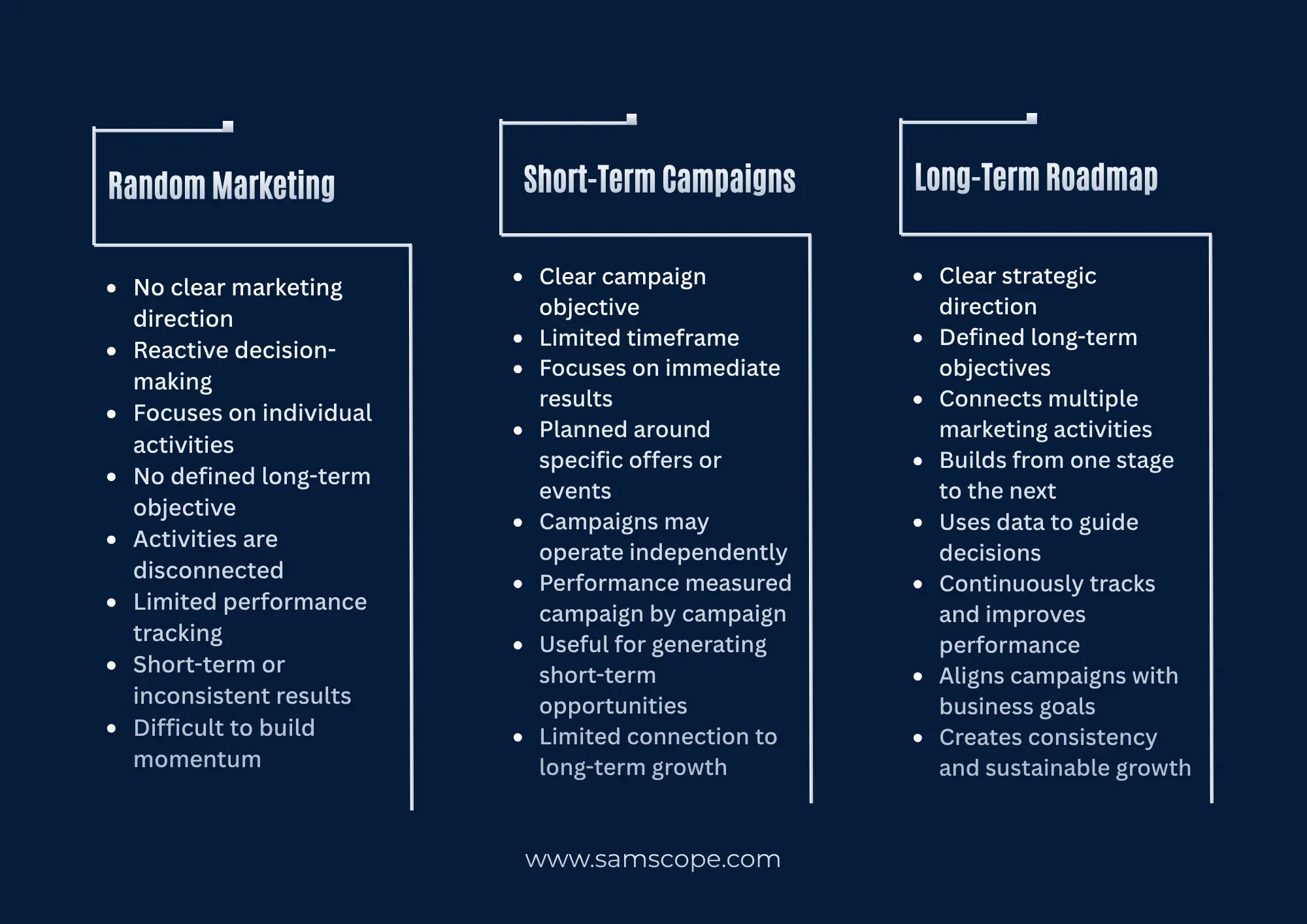
Random marketing activities lack a defined strategic direction. A social media post may be published simply because someone remembers to post, or an advertisement may be launched because there is unused budget available. These activities may generate occasional results, but they are not connected to a broader objective or measurable growth plan.
Short-term campaigns are more intentional. Examples include holiday promotions, product launches, seasonal campaigns, or limited-time offers. However, when managed independently, these campaigns often operate in isolation, with a defined start and end date but limited connection to previous activities or future marketing priorities.
A long-term marketing roadmap brings these activities together within a structured strategic framework. Short-term campaigns can still play an important role, but each campaign becomes part of a larger direction. Previous campaign performance informs future decisions, while the data and insights generated from each initiative help shape what comes next.
This approach reduces disconnected marketing activity and creates greater strategic consistency. Instead of treating every marketing action as a separate task, the business gives each activity a defined purpose, position, and role within its broader growth plan.
The visual below presents the key differences between Random Marketing Activities, Short-Term Campaigns, and a Long-Term Marketing Roadmap. It highlights how each approach differs in terms of strategic direction, planning, continuity, performance measurement, and contribution to long-term business growth.
Why Businesses Struggle Without a Marketing Roadmap
Without a clear roadmap that connects individual marketing decisions to broader business objectives, organizations often encounter recurring challenges regardless of their industry or size. Common issues include:
Inconsistent marketing execution: Marketing activities start and stop based on available time, resources, or immediate priorities rather than following a consistent plan.
Inefficient advertising spend: Budgets are repeatedly allocated to campaigns without sufficiently validating the underlying audience, positioning, or messaging assumptions.
Unclear priorities: Without a defined sequence of activities, it becomes difficult to determine which marketing initiatives should receive attention and investment next.
Repeated mistakes: Campaigns are launched without systematically analyzing previous results, causing the same ineffective approaches to be repeated.
Inconsistent brand communication: Messaging, positioning, and visual communication may vary across campaigns, making it harder to establish a consistent and recognizable brand identity.
Limited performance visibility: Without consistent objectives, metrics, and benchmarks, measuring progress and understanding whether marketing efforts are moving in the right direction becomes more difficult.
Short-term gains without cumulative growth: Individual campaigns may generate temporary results, but their impact does not consistently build toward sustainable, long-term business growth.
A marketing roadmap helps address these challenges by creating continuity between strategy, execution, measurement, and optimization. Instead of treating each marketing activity as an isolated effort, businesses can build a system where every initiative contributes to a broader growth objective.
Key Components of a Digital Marketing Roadmap
A comprehensive digital marketing roadmap is built around a series of interconnected strategic components. Each component contributes to the next, creating a structured framework that aligns marketing activities with the business’s current position, market opportunities, and long-term growth objectives.
Let’s take a visual look at the key components that make up a comprehensive digital marketing roadmap.
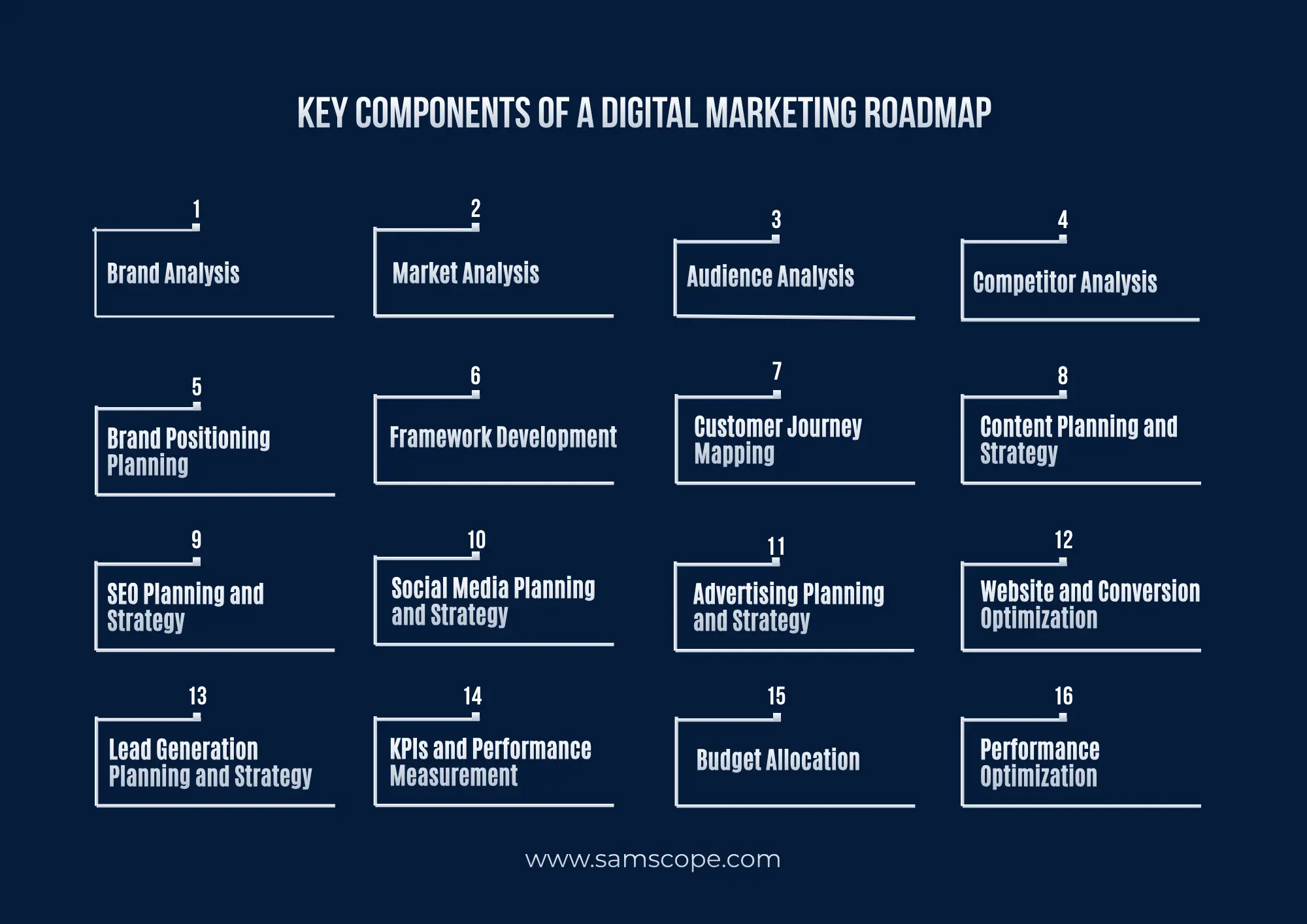
The visual above provides an overview of the key components of a digital marketing roadmap. Let’s now explore each component in detail to understand its role and contribution to the overall marketing strategy.
Brand Analysis: Assess the brand’s current position, identity, offerings, digital presence, strengths, weaknesses, and growth opportunities.
Market Analysis: Evaluate the market environment, trends, demand, opportunities, challenges, and relevant market dynamics.
Audience Analysis: Identify and understand the target audience, including their needs, behaviors, preferences, pain points, and decision-making factors.
Competitor Analysis: Analyze competitors’ positioning, offerings, communication, marketing activities, strengths, weaknesses, and market presence.
Brand Positioning Planning: Define how the brand should be positioned in the market and how it should differentiate itself in the minds of its target audience.
Framework Development: Develop a structured marketing framework that connects strategic objectives, channels, activities, resources, and performance measurement.
Customer Journey Mapping: Map the customer journey from awareness and consideration through conversion, retention, and continued engagement.
Content Planning and Strategy: Establish what content should be created, for whom, through which channels, and for what strategic purpose.
SEO Planning and Strategy: Develop a structured approach to improving organic search visibility, relevant traffic, search performance, and long-term discoverability.
Social Media Planning and Strategy: Define the appropriate platforms, content direction, publishing approach, audience engagement, and growth objectives.
Advertising Planning and Strategy: Establish paid advertising objectives, targeting, campaign structure, creative direction, budget allocation, testing, and optimization processes.
Website and Conversion Optimization: Improve website structure, user experience, messaging, landing pages, and conversion pathways to support business objectives.
Lead Generation Planning and Strategy: Develop systematic methods for attracting, capturing, qualifying, and nurturing potential customers.
KPIs and Performance Measurement: Establish relevant performance indicators, benchmarks, and measurement systems to evaluate progress and marketing effectiveness.
Budget Allocation: Allocate marketing resources according to strategic priorities, business needs, expected outcomes, and performance data.
Performance Optimization: Continuously analyze results and refine strategies, campaigns, channels, content, and resource allocation based on measurable performance.
These components do not operate independently. Brand and market analysis inform audience and competitor analysis; those insights shape positioning, content, channel, and advertising strategies; and performance data feeds back into the entire roadmap. This interconnected structure allows businesses to make informed decisions and continuously improve their marketing approach.
The result is a roadmap that provides clear strategic direction while remaining flexible enough to adapt to changing customer behavior, market conditions, and performance data. Rather than becoming an outdated plan, it functions as an evolving framework for sustainable digital growth.
How a Roadmap Helps You Allocate Your Marketing Budget
A marketing roadmap does more than outline what a business should do; it helps determine what should be done first, where resources should be allocated, and when priorities should change.
For example, a newly launched e-commerce business may need to prioritize brand positioning, audience research, website readiness, and initial paid advertising to establish market presence and generate early traction. At this stage, there is often limited historical data, so the focus should be on building a strong foundation while gathering meaningful insights about customers and campaign performance.
As the business begins acquiring customers and generating performance data, the budget allocation can evolve. A growing startup may place greater emphasis on content marketing and SEO to build organic visibility and create sustainable traffic over time. Meanwhile, a more established business with a strong customer base may allocate additional resources toward customer retention, remarketing, and conversion optimization to increase the value of existing traffic and customers.
The appropriate allocation therefore depends on the business’s current stage, objectives, available data, customer base, market conditions, and performance across channels.
Without a roadmap, marketing budgets are often distributed across multiple activities without a clear strategic priority or shifted toward whichever channel happens to be receiving attention at the time. A structured roadmap helps ensure that budget decisions are connected to actual business needs and adjusted as the business progresses through different stages of growth.
Role of Data, KPIs & Continuous Optimization
Data, KPIs, and continuous optimization are essential to keeping a digital marketing roadmap on course. A marketing plan should not be treated as a fixed set of instructions that remains unchanged after implementation. Instead, it should be monitored continuously and refined based on actual performance and changing market conditions.
KPIs such as website traffic, conversion rate, cost per acquisition (CPA), customer acquisition cost (CAC), return on ad spend (ROAS), engagement, and lead generation provide measurable indicators of whether marketing activities are delivering the intended results. These metrics help businesses identify which channels and initiatives are performing effectively and where adjustments may be necessary.
Continuous optimization then turns these insights into action. This may involve refining messaging or creative assets, improving landing pages, adjusting audience targeting, reallocating budget from underperforming channels, or testing different content and campaign approaches.
The broader objective—sustainable business growth—remains consistent, while the methods used to achieve it can evolve based on evidence. Without regular measurement and optimization, businesses may continue investing in ineffective activities without recognizing that their marketing performance has moved away from the intended direction.
An effective roadmap therefore creates a continuous cycle of planning, implementation, measurement, analysis, optimization, and improvement. This ensures that marketing decisions remain informed by real performance data rather than assumptions alone.
How a Long-Term Roadmap Supports Sustainable Business Growth
Sustainable business growth rarely comes from a single successful campaign. It is typically built through a consistent strategic direction that remains focused on long-term objectives while allowing individual tactics to evolve based on performance and changing market conditions.
A long-term roadmap enables businesses to follow a continuous cycle of testing, measuring, learning, and improving. A business can test a message or campaign, analyze how its target audience responds, identify what worked and what did not, and apply those insights to the next phase of its marketing strategy. Instead of starting from scratch with every campaign, each activity contributes knowledge and performance data that can strengthen future decisions.
A roadmap should therefore provide direction without becoming rigid. Market conditions change, customer expectations evolve, competitors introduce new approaches, and new performance data can reveal insights that were not available when the original plan was developed.
By incorporating ongoing measurement, testing, and optimization, a marketing roadmap can remain relevant as the business and its market evolve. In contrast, a rigid, one-time marketing plan can quickly become outdated when the assumptions behind it no longer reflect current market conditions.
The result is a more connected approach to marketing, where each phase builds on previous learning and contributes to the business's broader objective of sustainable, measurable growth.
Why Businesses Choose Samscope?
Building a long-term marketing roadmap from the ground up—and keeping it relevant as business conditions, customer behavior, and market dynamics evolve—requires a structured and data-driven approach. Samscope’s Strategic Digital Marketing Solution for Sustainable Growth is designed to support businesses throughout this process.
Every engagement follows a structured approach: analyze the business, audience, and market; develop a clear strategic direction; implement the strategy across the appropriate channels; measure performance; optimize based on data; and scale the approaches that demonstrate meaningful results.
Businesses working with Samscope are not simply provided with a fixed marketing plan and left to manage implementation independently. The roadmap is continuously reviewed and refined as new performance data and market insights become available. This allows the overall strategic direction to remain aligned with business objectives while the specific tactics evolve according to what the data reveals.
Through this approach, Samscope helps businesses move from disconnected marketing activities toward a structured, measurable, and continuously improving digital growth system.
Conclusion
Sustainable growth rarely comes from simply spending more on marketing. It is built through clear strategic direction, consistent execution, informed decision-making, and continuous performance improvement.
When marketing feels like a series of disconnected campaigns rather than a coordinated growth strategy, the missing element may be a clear long-term roadmap. A well-structured roadmap connects business objectives with audience insights, marketing activities, performance measurement, and ongoing optimization—allowing each initiative to contribute to a broader growth direction.
If your business is ready to move from fragmented marketing activities to a more structured and strategic approach, book a free consultation with Samscope and explore how a long-term digital marketing roadmap can be developed around your business objectives, market position, and growth goals.